

AI Creates More Persuasive Content Than “One Of The World’s Leading Consulting Firms”.
PLUS: FitFabFun Goes From BuzzFeed’s “Best Subscription Boxes Missing From Your Life” To “A Customer Revolt” In About A Month; and Two New Youth-Focused Polls.

In this edition:
AI Creates More Persuasive Content Than “One Of The World’s Leading Consulting Firms”.
FitFabFun Goes From BuzzFeed’s “Best Subscription Boxes Missing From Your Life” To “A Customer Revolt” In About A Month.
Two New Youth-Focused Polls.
New empirical research or polling you’re working on, or know of, that’s interesting? We’d love to hear from you! Please send ideas to hi@notesonpersuasion.com.
1. AI Creates More Persuasive Content Than “One Of The World’s Leading Consulting Firms”.
Professors Yunhao Zhang and Renee Gosline from the Massachusetts Institute of Technology’s Sloan School of Management teamed up with “one of the world’s leading consulting firms” to “create advertising content for products and persuasive content for campaigns.” They also paid $20 to subscribe to ChatGPT-4 to do the same.
And yikes …
“Content generated by generative AI is perceived as of higher quality than that produced by human experts[.]”
“Revealing the source of content production,” which means that study participants know which content AI created, “reduces—but does not reverse—the perceived quality gap between human and AI-generated content.”
Humans prefer human-created content, all things being equal. But all things are not equal. As the researchers note, “ChatGPT-4 outperforms human experts in generating advertising content for products and persuasive content for campaigns,” does so in “a matter of seconds,” and at “less cost”.
The preference for human content “is predominantly driven by human favoritism rather than AI aversion.” How do we know? “Knowing the same content is created by a human expert increases its perceived quality,” but “knowing [that] a piece of content [was] generated with AI’s involvement does not lower the level of satisfaction and willingness-to-pay for the content.”
Related: Notes on Persuasion recently covered a study concluding that propagandists could use GPT-3—the earlier generation of ChatGPT—“to generate persuasive articles with minimal human effort, by using existing articles on unrelated topics to guide GPT-3 about the style and length of new articles.”
2. FitFabFun Goes From BuzzFeed’s “Best Subscription Boxes Missing From Your Life” To “A Customer Revolt” In About A Month.
Here’s Business Insider’s Katie Notopoulos describing the epic meltdown, which, as we’ll get to in a minute, steps from a communications strategy misstep:
“FabFitFun, the subscription box company aimed at women, is facing a backlash from some of its customers over an ad it ran on Elon Musk's X, formerly known as Twitter. The ad echoed what Elon Musk said in an interview last week when he told advertisers who would drop X to ‘go fuck’ themselves. The FabFitFun post, which was run as a paid ad on X, promised that the company was pledging an extra $100,000 in advertising on the X platform ‘in support of its free speech ideals. It also offered new customers a free gift if they signed up with code: GoFuckYourself.’”
As Lulu Cheng Meservey, the author of the Flack newsletter whose “day job is running corporate affairs and communications for Activision Blizzard,” wrote on X, this is “what happens when your comms are unmoored from business goals, you don’t know your audience, your values aren’t aligned with your users, and you don’t commit to a clear stance.”
Here’s the more detailed version of Meservey’s analysis, which is worth memorizing, not only if you are a communications professional, but if you are making any public-facing decisions for a company or cause:
“(1) They made a big $100k bet without a clear business goal. One of the cofounders described the goal behind the ad as “be so outrageous that it could go viral.” That’s not a valid goal. Being outrageous, going viral, getting press, being the cool kid at a conference, “telling our story” - none of these are valid goals. Real goals are things like getting users or attracting talent. FFF was flying blind.”
“(2) They spoke to the wrong audience on the wrong platform. FFF users are Gen Z women! Their products are things like scented candles! Their main platform is IG! A profane ad on X only had a downside. Elon fans were not going to start ordering monthly scented candles. It could ONLY have gone viral in the wrong way.”
“(3) They were values misaligned with users. Supporting free speech is a legitimate, even admirable, core value. But if that was a core value for FFF, that was news to their users (again, young women), who felt shocked and bewildered. Users felt like FFF ambushed them with a stance that not only upset them but had nothing to do with the business. I’ve defended plenty of unpopular or controversial stances for companies, but only when it’s relevant to the business and target audiences. Companies don’t have to take a stand on every issue!”
“(4) Their response was weak. FFF was slow to respond and when they did, it was a tepid apology. Taking a principled stand only works when you actually take a stand, even if people get mad. OR, don’t take a stand in the first place and just focus on selling candles. OR, fully own the apology and fix what went wrong. Any of these can work. But by not choosing a lane — again, lack.”
An important wrinkle in this story is that both the pro-Elon Musk stance and pro-free speech values have “nothing to do with the business” of selling candles, but they do reflect the public positions of FitFabFun’s co-founder and co-CEO. Whether you run the hottest startup, a Fortune 100 company, or a non-profit organization, it is critical—especially in charged political moments—to take a step back and separate your beliefs from the organization’s beliefs, not only before deciding how to respond to public events, but whether it makes sense to respond at all. This is an especially important—and difficult—lesson for founders, who often see their organizations as an extension of their own identities.
3. Two New Youth-Focused Polls:
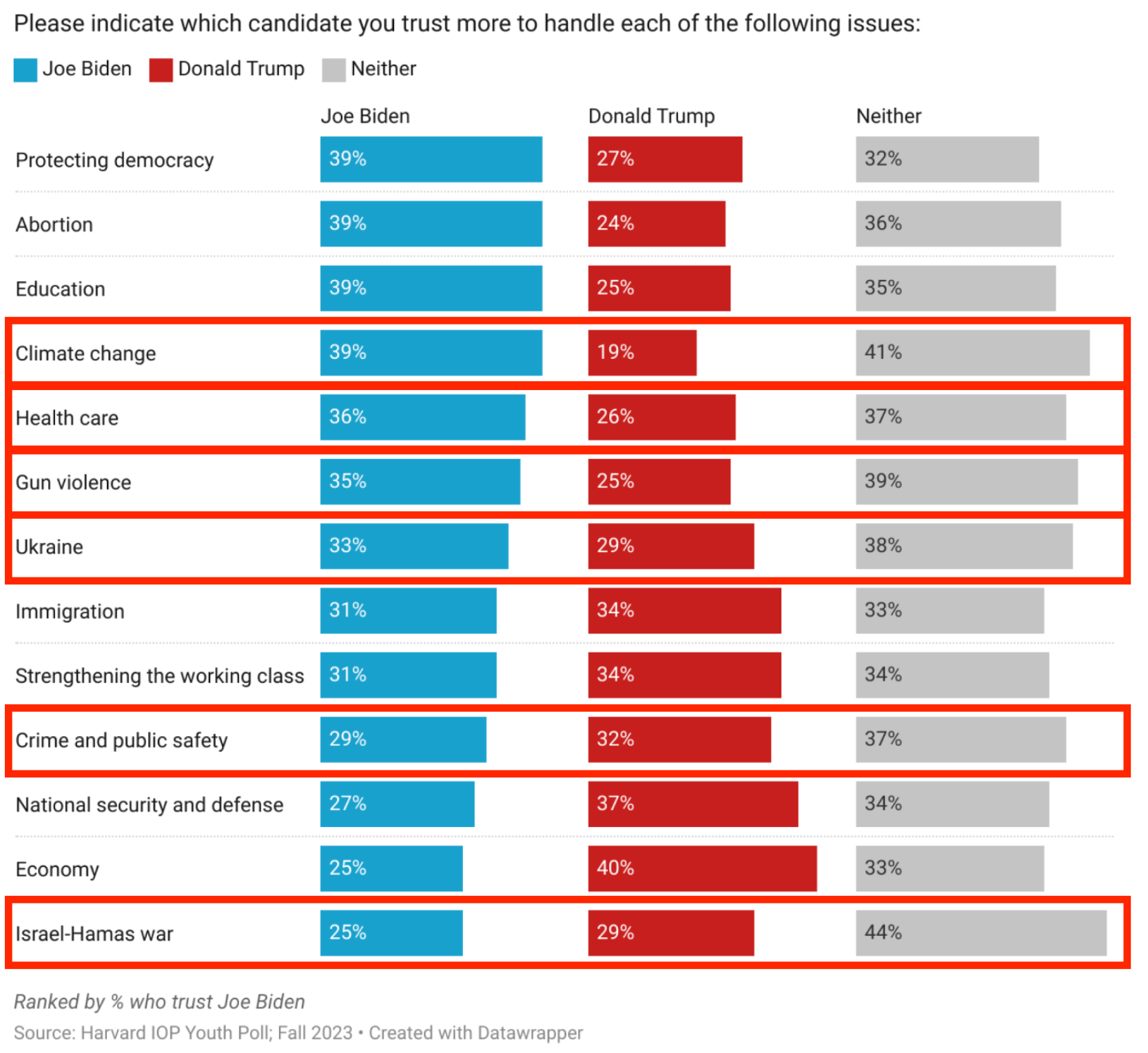
Harvard Youth Survey. The Harvard Institute of Politics surveyed over 2,000 “young Americans” between the ages of 18 and 29 to gauge “attitudes toward politics and public service.” The whole survey is worth a read, but here’s the finding that stuck with us the most: “A plurality trusts neither Biden nor Trump on important issues like the Israel-Hamas war, Ukraine, climate change, gun violence, health care, crime and public safety.”
Gallup: Since 2000, the percentage of Americans who believe that juveniles between the ages of 14 and 17 should be treated the same as adults when they commit a violent crime has decreased by nearly twenty percentage points—from 65% in 2000 to 46% in 2023, a new poll from Gallup found. At the same time, the percentage of Americans who believe that juveniles “should be given more lenient treatment in a juvenile court” increased from 24% in 2000 to 47% in 2023.
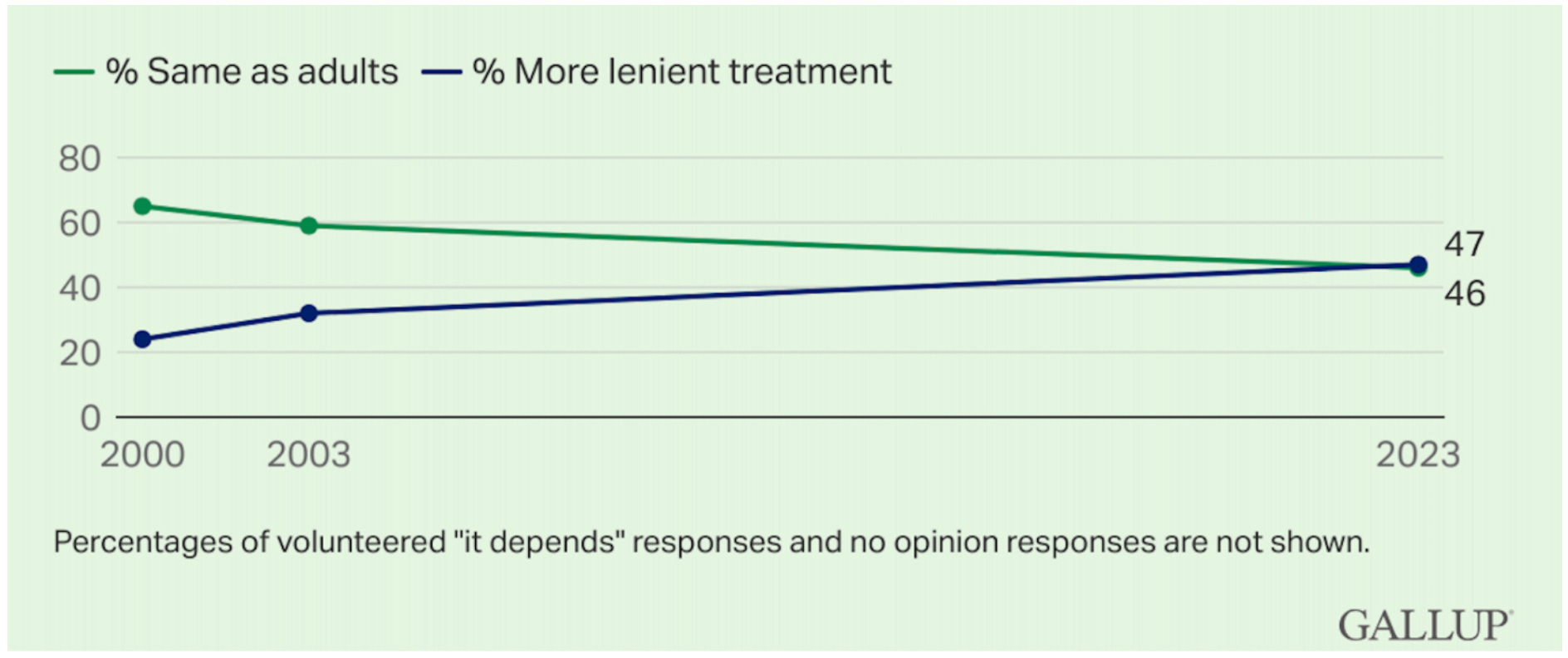
This shift in public attitudes corresponds with growing scientific understanding of how juvenile and adult brains differ. In short, as the U.S. Supreme Court has explained, “as compared to adults, juveniles have a lack of maturity and an underdeveloped sense of responsibility; they are more vulnerable or susceptible to negative influences and outside pressures, including peer pressure; and their characters are not as well formed.”